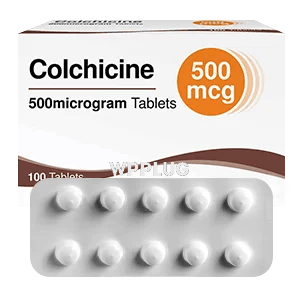
| Product dosage: 0.5mg | |||
|---|---|---|---|
| Package (num) | Per pill | Price | Buy |
| 60 | $0.95 | $57.23 (0%) | 🛒 Add to cart |
| 90 | $0.79 | $85.85 $71.29 (17%) | 🛒 Add to cart |
| 120 | $0.70 | $114.47 $84.34 (26%) | 🛒 Add to cart |
| 180 | $0.62 | $171.70 $112.46 (35%) | 🛒 Add to cart |
| 270 | $0.57 | $257.55 $152.62 (41%) | 🛒 Add to cart |
| 360 | $0.54
Best per pill | $343.40 $193.79 (44%) | 🛒 Add to cart |
Synonyms | |||
More info:
Colchicine: Targeted Anti-Inflammatory Protection for Gout and Beyond - Evidence-Based Review
Colchicine is a naturally occurring alkaloid derived from the autumn crocus (Colchicum autumnale) and Gloriosa superba plants. It has been used medicinally for centuries, with its first recorded use dating back to ancient Egypt around 1500 BC for treating joint swelling and pain. In modern medicine, colchicine is classified as an anti-inflammatory agent with a unique mechanism distinct from NSAIDs and corticosteroids. Its primary medical application centers around acute gout flares and familial Mediterranean fever (FMF), though recent research has expanded its potential uses into cardiovascular and other inflammatory conditions.
allopurinol
Allopurinol is a xanthine oxidase inhibitor, a medication primarily used to manage chronic hyperuricemia and prevent gout flares and uric acid nephrolithiasis. It’s not a dietary supplement or medical device but a prescription drug with a well-established role in clinical practice for decades. I remember first encountering it as a junior resident—our attending physician would call it the “long-term solution, not the quick fix,” which really stuck with me. It’s fascinating how this drug, despite its simplicity, requires careful patient selection and monitoring to avoid pitfalls.
benemid
Probenecid, originally marketed as Benemid, represents one of those fascinating pharmaceutical artifacts that somehow managed to transcend its original purpose. Developed in the 1950s by Merck & Co., this uricosuric agent was specifically designed to treat gout by increasing renal excretion of uric acid. What’s particularly interesting is how its mechanism—competitive inhibition of organic anion transporters in the proximal tubule—later revealed unexpected applications beyond its initial gout indication. The drug exists as a white, crystalline powder with moderate water solubility, typically formulated as 500 mg tablets for oral administration.
biaxin
Biaxin, known generically as clarithromycin, is a macrolide antibiotic with a distinctive 14-membered lactone ring structure that’s been modified from erythromycin to enhance acid stability and tissue penetration. What’s fascinating clinically isn’t just its broad-spectrum coverage against respiratory pathogens, but how its unique metabolite, 14-hydroxy-clarithromycin, creates this synergistic antibacterial effect that’s particularly valuable in stubborn bronchitis cases. Key Components and Bioavailability of Biaxin The molecular structure contains a methoxy group at the 6-position - that’s the key modification that reduces acid degradation in the stomach compared to erythromycin.
dapsone
Dapsone, a sulfone antimicrobial agent, has been in clinical use since the 1950s, primarily for dermatological conditions like dermatitis herpetiformis and leprosy. Its mechanism involves inhibition of bacterial folate synthesis and potent anti-inflammatory effects through suppression of neutrophil-mediated responses. We’ve found it particularly valuable for off-label uses in various autoimmune blistering diseases and inflammatory dermatoses where conventional therapies fall short. Dapsone: Targeted Anti-Inflammatory and Antimicrobial Action - Evidence-Based Review 1. Introduction: What is Dapsone?
Ilosone: Effective Bacterial Infection Treatment - Evidence-Based Review
Erythromycin estolate, marketed under the brand name Ilosone, represents a significant advancement in macrolide antibiotic therapy, specifically designed to enhance stability and patient compliance through its unique estolate salt formulation. This oral preparation has been a cornerstone in treating various bacterial infections, particularly in pediatric and outpatient settings, due to its improved acid stability and absorption profile compared to earlier erythromycin forms. 1. Introduction: What is Ilosone? Its Role in Modern Medicine Ilosone contains erythromycin estolate as its active pharmaceutical ingredient, belonging to the macrolide class of antibiotics.
lipitor
Lipitor, known generically as atorvastatin calcium, represents one of the most widely prescribed and studied HMG-CoA reductase inhibitors in modern cardiovascular pharmacotherapy. Developed initially by Warner-Lambert and later by Pfizer, this synthetic statin has fundamentally reshaped lipid management protocols since its FDA approval in 1996. Unlike earlier natural statins derived from fungi, Lipitor’s fully synthetic structure allows for enhanced potency and predictable pharmacokinetics, making it a cornerstone therapy for atherosclerotic cardiovascular disease (ASCVD) risk reduction across diverse patient populations.
voveran
Voveran, known generically as diclofenac, is a nonsteroidal anti-inflammatory drug (NSAID) available in oral, topical, and injectable formulations. It’s primarily indicated for pain and inflammation management across various conditions, from osteoarthritis to acute musculoskeletal injuries. What sets Voveran apart in clinical practice isn’t just its potency—it’s the specific pharmacokinetic profile that allows for flexible dosing across different patient populations. I’ve seen it work where other NSAIDs plateau, particularly in inflammatory arthritis cases where rapid onset of action matters.
zyloprim
Zyloprim represents one of those foundational medications that quietly revolutionized management of chronic conditions. When I first encountered it during my rheumatology fellowship, we were still relying heavily on colchicine and NSAIDs for gout flares, with all their gastrointestinal consequences. The introduction of allopurinol (the generic name for Zyloprim) fundamentally shifted our approach from reactive to preventive care. ## 1. Introduction: What is Zyloprim? Its Role in Modern Medicine Zyloprim contains the active pharmaceutical ingredient allopurinol, a xanthine oxidase inhibitor that fundamentally alters uric acid metabolism.